Bremen, Ohio oil boom

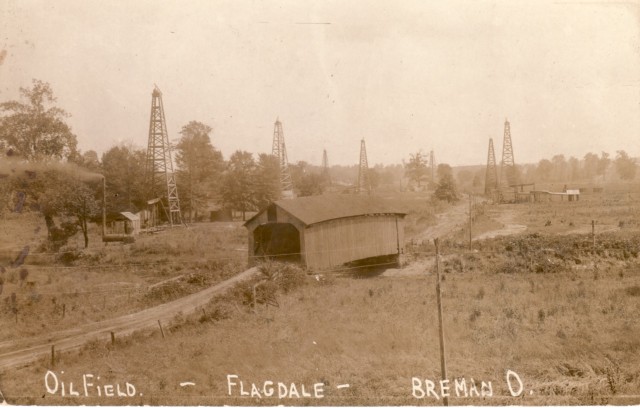
The Bremen Gas and Oil Company J.W. Huston well is generally credited as the discovery well for the Bremen oil field of south-central Ohio (Fairfield County).  Drilled and completed in the fall of 1907, the well tested at a rate of 140 barrels of oil per day.  In February, 1908 the Bremen Stock Exchange had been formed with a listing of 36 companies.  Drilling moved into the town itself, and by mid-1910, thirty-six wells had been drilled on town lots.  Drilling spread throughout the neighboring counties and several other oil fields were discovered. The Bremen oil boom lasted into the early 1920s.  Many real photo postcards (RPPCs) of the oil boom show the town lot drilling, oil field fires, and scenes of derricks and oil storage tanks.  The postcards on this blog post include the postcard used for the blog header and for the cover of Ohio Oil & Gas (2008).

SPENCER, Jeff A., 2008, A journey through two early Ohio oil booms, the Northwest    Ohio and the Bremen-New Straitsville booms, Oil-Industry History, v. 9, p. 59-72.

Bremen OH bridge oilfield rppc

Oil field fiction – 1940s-50s

Oil field fiction.  Bright Danger (1941), Black Gold (1950), and When Oil Ran Red (1952).

Bright Danger includes the fictional towns of Beauport and Saragossa; most probably taken from the Texas boomtowns of Beaumont and Saratoga.  A “vigorous yarn about one of the most dangerous jobs in the world – the job of putting out oil well fires.” (Bright Danger)


Texas oil cachets – Air mail feeder survey flights – 1937

An experiment with a “feeder system” carrying mail within five states, North Carolina, Georgia, New Jersey, Florida, and Texas, took place during “Airmail Feeder Week,” December 6-12, 1937.

In Texas, small planes carried mail to Houston from smaller Texas towns for connections to main airmail routes. Eastern Air Lines was the Texas carrier and some sources state that 38 Texas towns participated; other sources mention 50.  Special boxes were placed in post office lobbies days in advance and postmasters encouraged patrons to bring their letters for participation in this postal event. Generic and local cachets were designed for envelopes.  Oil-related Texas Air Mail Feeder Survey Flight cachets include ones from the towns of Ranger, Port Arthur, Electra, Graham, and Odessa.  This Port Arthur example shows a refinery and the slogan, “We oil the world” and was addressed to the Texas Company at 135 East 42nd Street, New York City, New York.  The Texas Company, later Texaco, leased fourteen floors at this address…..the Chrysler Building!

Oil Well Willie

The Howdy Doody Show was one of the most popular children’s programs in television history (December 27, 1947-September 24, 1960). Oil Well Willie, played by Bill LeCornec, searched for oil, but never found any. Willie was often described as a “Gabby Hayes” type character.

This card was cut from a 1950 Royal Dessert Pudding box and was card #14 in a set of 16. The caption on a complete box: “Royal Trading Card Howdy Doody No. 14. Oil Well Willie hadn’t struck oil in many years but he struck up many friendships when he moved to Doodyville. Now this old prospector helps Buffalo Bob keep order in Doodyville and continues his search for oil wells.”

SPENCER, Jeff A., 2009, The petroleum history in trade cards, trading cards, and comic books, Oil-Industry History, v. 10, p. 115-119.

willie-05

Louisiana’s Lower Tuscaloosa Trend 40+ years later

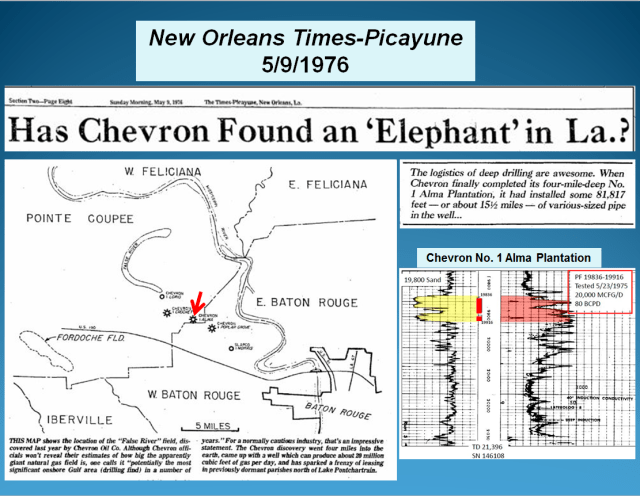
On May 31, 1975, 15 miles northwest of Baton Rouge, the Chevron No. 1 Alma Plantation well was completed as the discovery well for the False River Field. Completed from perforations at 19,836–19,916 feet with a rate of 20 million cubic feet of gas per day (MMCFGD) and 80 barrels of condensate per day (BCPD), the well opened the prolific South Louisiana Lower Tuscaloosa Trend.

Almost a year later, after Chevron drilled offset confirmation wells, the New Orleans Times-Picayune reported on the potential “elephant” – False River field.

SPENCER, Jeff A., 2015, The 40th anniversary of South Louisiana’s Lower Tuscaloosa Trend   recollections and early media coverage, Gulf Coast Association of Geological Societies Transactions, v. 65, p. 361-376.alma full display blog

Stories in postcards – Raymilton, PA 1911

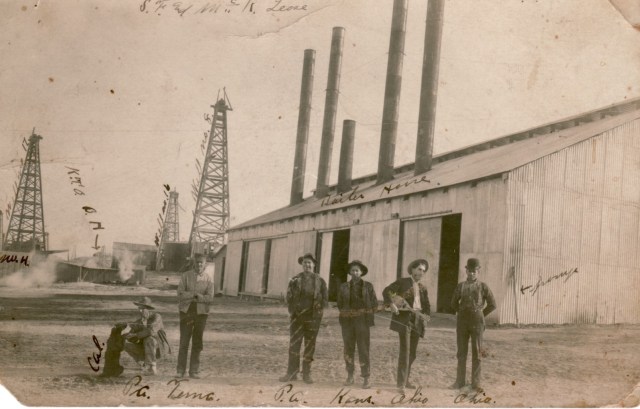
This real photo postcard, with a “received”postmark of Raymilton, PA, Oct. 20, 1911, is a good example of the stories that can be found on old postcards.  On the front of the postcard, the sender has written  below each oil worker, perhaps the state each is from.  The dog(?) is labeled “Cal.” The boiler house is identified, four derricks/wells are numbered, the lease name is mentioned, and perhaps the company name –  “K.T.O”? There was a K.T.O. (Kern Trading & Oil Co., a holding of Southern Pacific Railroad). Do the clues suggest that the postcard was sent from the California oilfields back to PA?  The note on the reverse, in part, reads, “Things are pretty dull out here now, but I’m working every day and check this month is $94.97 clear.”


PA Raymilton rppc

Potrero del Llano No. 4 oil gusher

Potrero del Llano No. 4 well.

On December 27, 1910, the Mexican Eagle Co. LTD/Pearson  Potrero del Llano No. 4 well erupted, gushing oil 250 feet into the air. The well was initially capped in late January, 1911, but it was almost two months later before the well was controlled.

During those 3 months, the well ran wild with an estimated flow rate of 100,000 to 110,000 barrels of oil per day. The well was located near Tuxpan, approximately 300 km northwest of Veracruz, Mexico.  After the well was controlled and put into production, it produced at rates up to 45,000 barrels of oil per day and produced over 25 million barrels of oil in its first three years.  In August, 1914 an electrical storm ignited seepages around the well and the fire burned for six months.  These real photo postcards (RPPCs) show the gusher and the earthen pits dug to temporarily store the oil.

Mount, Houston Faust II, 2014, Oilfield Revolutionary – The Career of Everette Lee DeGolyer; Texas A&M University Press, 352 pp.

Fuel Oil Journal, v. 5, Feb., 1914, p. 4.

Fuel Oil Journal, v. 6, Jan., 1915, p. 3.


Souvenir china – oilfield examples

I’m putting together a different sort of poster presentation for the 2016 Oil History Symposium in Casper, WY next month.  Searching the internet, using examples from my own collection, and with help from some museums and other collectors, I’ve put together many examples of souvenir china with petroleum themes.  These include oil gushers, oilfield scenes, refineries, gas wells, and oil tank fires.   Souvenir china, especially pieces made by the Wheelock Company, were popular in the late 1800s and early 1900’s.  Here are three examples from my collection.  Anyone out there have any?

When an oil gusher might not be an oil gusher

Buffalo Medical Journal,1914, v. 7. p. 37, advertisement.  Postcard postmarked May 6, 1913.

The historical marker at the site of Alden’s Black Water Mineral Baths: “In 1891, black mineral water was found while drilling for gas. Medicinal value as ‘nature’s remedy for rheumatism’, in 1903, became world famous. The ‘original baths’, a frame bath house, opened November 1904. Erected by Erie County Sesquicentennial Committee 1971”